

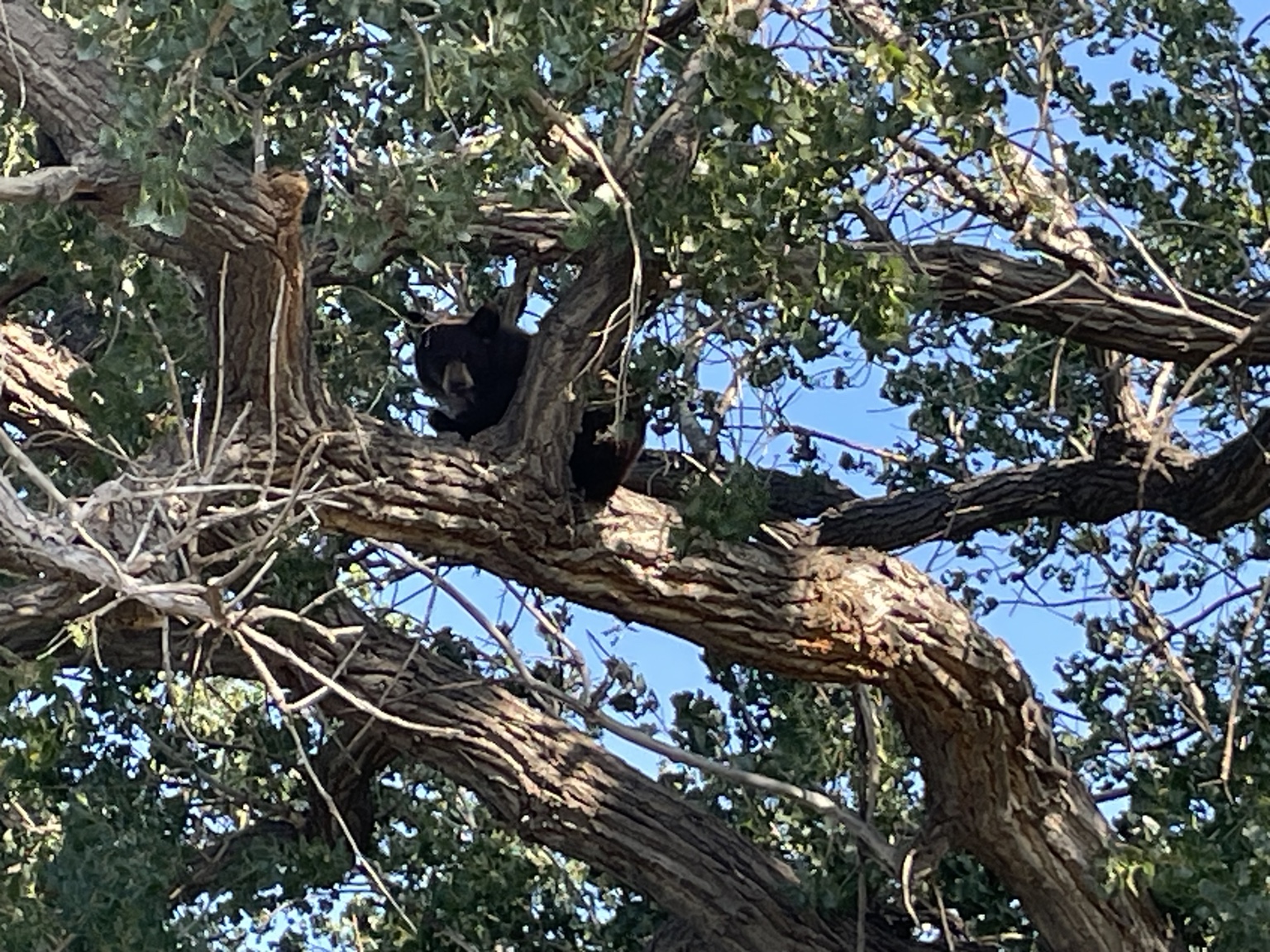
Two black bears of noticeably different sizes were observed about nine miles apart in Prowers County on September 5 and 6, during an unusually active year for bears across Colorado.
On Saturday, September 5, an adult-sized black bear was spotted approximately 10 miles south of Carlton, Colorado. The bear ran out of a cornfield and headed in the direction of Wolf Creek.
The following day, about nine miles away, a much smaller black bear appeared at a ranch house approximately six miles south of Granada along Granada Creek.
Dogs had treed the smaller bear in the yard. When the landowner arrived, the bear came down, ran into Granada Creek and climbed another tree, where it remained when the landowner left. Dey Money has video of the encounter.
The bear appeared young, but its age has not been confirmed by a wildlife biologist.
Nor is there evidence establishing a relationship between the two animals. Their different sizes, proximity and consecutive appearances naturally raise the question, but we cannot say they were traveling together, were related or even arrived in Prowers County for the same reason.
What we do know is that their appearance coincides with an extraordinary year for black-bear activity across Colorado.
Colorado Is Seeing Far More Bear Activity in 2026
Through August 31, Colorado Parks and Wildlife had received 8,672 reports of bear sightings and incidents, compared with 3,680 during the same period in 2025. The 2026 figure was 3.6 times the recent five-year average.
CPW had also relocated 98 bears, compared with 33 at the same point last year, and euthanized 294, compared with 83.
CPW has described 2026 as an extraordinary drought and fire year and has connected poor natural food conditions with increased bear activity. Bears entering late summer and fall also begin feeding intensively to accumulate fat before winter.
That provides strong evidence that environmental conditions are contributing to unusual bear activity across Colorado.
It does not establish why these particular bears appeared in Prowers County.
How Unusual Are Bears This Far East?
Black bears are primarily associated with Colorado's mountains, foothills and wooded canyon country, and CPW's principal bear management areas are concentrated well west of Prowers County.
But southeastern Colorado is not entirely outside the species' documented history.
CPW range information identifies bear range in portions of Bent County, and historical records document bears in the canyon country around Baca County. There is also a historical account of a wandering black bear eventually reaching Kiowa County.
What our research has not established is how frequently wild black bears have been documented in Prowers County itself.
For that reason, it would be premature to describe these as the county's first bear sightings. Colorado Parks and Wildlife is in a better position to determine how unusual the September sightings are and whether the agency has received other recent reports from the lower Arkansas Valley.
Drought Offers One Plausible Explanation
Drought is the clearest environmental factor worth considering.
Colorado entered September amid widespread drought, and CPW has specifically connected dry conditions and poor natural food production with increased bear activity in 2026. When natural foods become scarce, bears can travel farther while searching for calories.
The first Prowers County bear happened to emerge from a cornfield. Black bears are known to eat corn and other agricultural crops, but there is no evidence that crop damage was involved here, and the observation alone cannot tell us whether the animal had been eating, resting or simply moving through the field.
More interesting geographically may be the area's creek bottoms.
The first bear moved toward Wolf Creek, while the second was encountered along Granada Creek. Research elsewhere has shown that bears can use drainages and riparian vegetation as travel cover through otherwise open landscapes.
That makes creek bottoms a plausible way for bears to move through southeastern Colorado. It does not establish the route either of these animals actually traveled.
What About Wolves and Bear Hunting?
Two other changes occurring in Colorado naturally raise questions: the restoration of gray wolves and changes over time in black-bear hunting and management.
Neither can currently be tied to the Prowers County sightings.
Colorado's restored wolf population is concentrated primarily in western Colorado, while Prowers County lies far to the southeast. Research from ecosystems where wolves and black bears coexist also shows a complicated relationship rather than simple displacement. Bears may avoid wolves during some encounters, compete with them around carcasses, or benefit from food left at wolf kills.
That leaves little basis for saying wolf restoration caused bears to move onto the southeastern plains. But Colorado's wolf population is changing at the same time the state is experiencing exceptional bear activity, and the ecological relationship is worth continuing to examine rather than dismissing a possible connection without evidence either way.
Bear management deserves similar caution.
Colorado continues to manage black bears partly through hunting, and CPW adjusts license availability and harvest objectives according to management goals. Hunter participation, harvest, population conditions and management policy have all changed over time.
Those trends may be relevant to understanding Colorado's broader bear population and distribution. What we do not currently have is evidence connecting a particular hunting or management change with bears appearing in Prowers County.
In both cases, correlation is worth investigating, but it is not causation.
What This Means in Cattle Country
Black bears should not suddenly be treated as a major cattle predator on Colorado's southeastern plains. Their natural diet is predominantly plant material, although bears can kill calves and other livestock under some circumstances.
For cattlemen here, the immediate significance may simply be that an animal traditionally associated with different country can show up around livestock, dogs, feed, water and ranch yards.
The September 6 encounter demonstrates that point particularly well. Dogs encountered the bear at a house and treed it twice. A cattleman who has spent a lifetime in Prowers County may simply not expect to find a black bear in a yard.
Unusual sightings should be reported to CPW, particularly when bears appear around homes or livestock. If livestock is injured or killed, prompt reporting also matters for documenting the circumstances and determining whether wildlife damage programs apply.
What We Still Don't Know
There are more questions than answers surrounding the two sightings.
We do not know where the bears came from. We do not know whether they were related. We do not know whether drought, population dynamics, wildlife-management changes or some combination of factors influenced their movements.
What we can establish is more limited—and interesting enough on its own.
Two black bears of markedly different sizes were observed roughly nine miles apart on consecutive days in Prowers County, during a year when Colorado is recording exceptionally high bear activity.
Drought provides an evidence-backed explanation for why bears are moving more widely across Colorado. The significance of wolf restoration, hunting and management changes is considerably less clear. And whether any of those factors explains these particular animals remains unknown.