

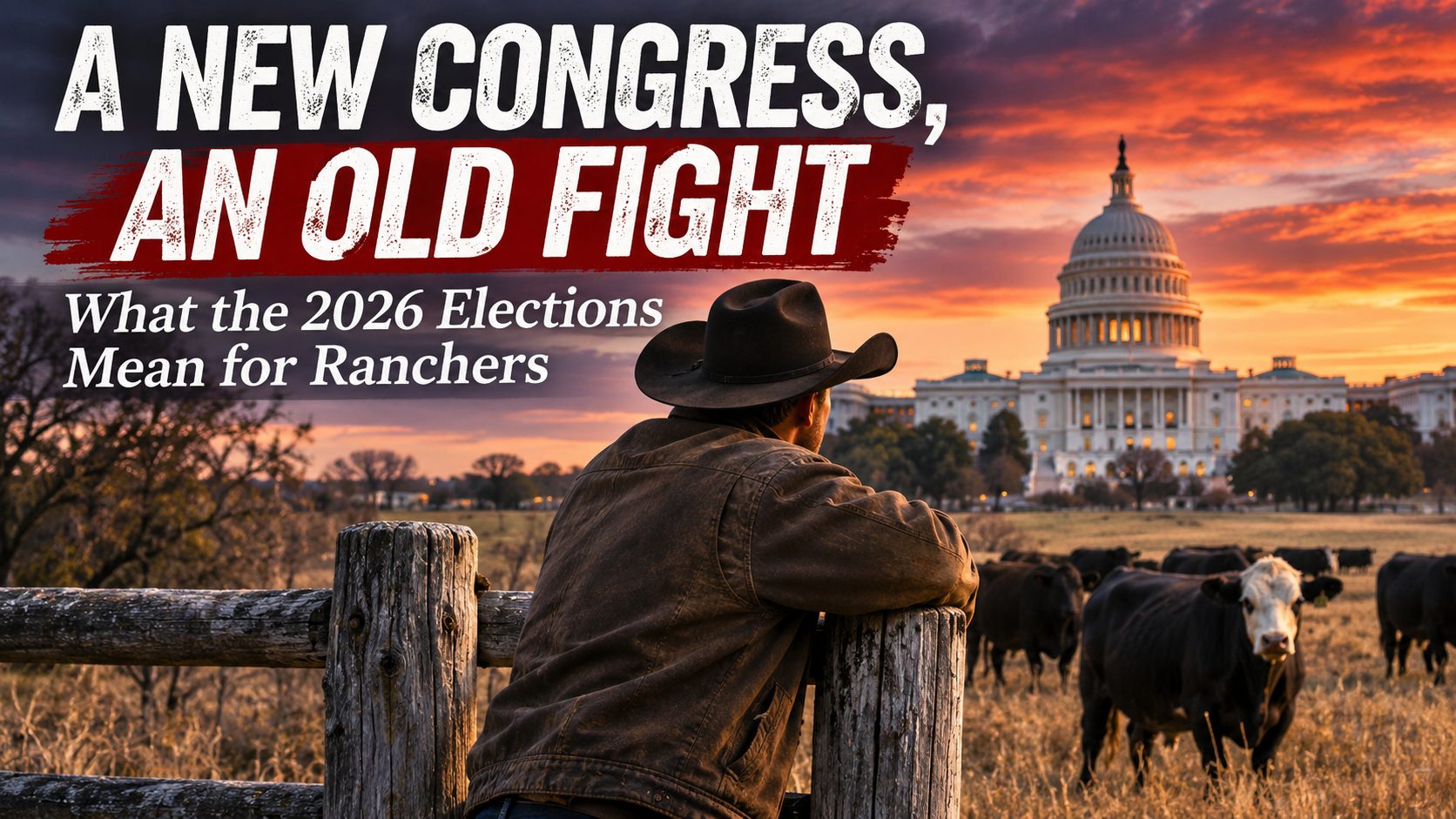
Democrats are positioned to take control of Congress, agricultural committees are losing longtime members, and several cattle-producing states are preparing for new leadership. For ranchers already contending with high operating costs, predator losses, and uncertainty over federal policy, the election raises consequential questions.
Election analysis based on the November 4 results and reporting supplied. Some races remain uncalled, and the new Congress has not yet organized.
Bottom Line Up Front
The 2026 midterm elections have delivered a substantial change in the political landscape of American agriculture.
As of Wednesday evening, Democrats were leading or had won 238 House seats and 54 Senate seats, according to election snapshots shared with Dey Money. Those totals included races that had not yet been called, but they pointed toward Democratic control of both chambers when the 120th Congress convenes in January.
The consequences extend beyond party control. Longtime agricultural lawmakers are retiring, losing elections, or leaving Congress to pursue other offices. Several members of the House and Senate Agriculture Committees will not return.
For cattlemen, the question is not simply which party won. It is who will write the next Farm Bill, who will oversee federal land agencies, and how incoming leaders will approach livestock markets, grazing rights, predator management, water, and private property.
There is good reason to pay attention. A change in Washington can eventually reach all the way to a grazing allotment, a stock tank, or a rancher's operating line.
A changing Congress inherits unfinished business
The Agriculture Committees were already facing substantial turnover before Election Day.
DTN reported that at least nine House Agriculture Committee members and five Senate Agriculture Committee members were expected to leave Congress, with further losses possible in competitive elections.
Among the departures identified were Iowa Sen. Joni Ernst, Kentucky Sen. Mitch McConnell, Illinois Sen. Dick Durbin, and Minnesota Sen. Tina Smith. On the House side, the departing members included Democratic ranking member Angie Craig of Minnesota, along with Republicans Dusty Johnson of South Dakota, Randy Feenstra of Iowa, and Don Bacon of Nebraska.
Then came the election.
According to the November 4 Farmdoc report, Kansas Republican Sen. Roger Marshall, a member of the Senate Agriculture Committee, lost to Democrat Adam Hamilton. House Agriculture Committee Republicans Zach Nunn of Iowa, Rob Bresnahan of Pennsylvania, Monica De La Cruz of Texas, and Derrick Van Orden of Wisconsin were also reported defeated.
That is a significant loss of institutional experience.
Agricultural legislation is rarely simple. The Farm Bill brings together commodity programs, conservation, nutrition assistance, rural development, and other competing priorities. Livestock producers must often compete for attention within a legislative process dominated by larger spending programs.
A new committee majority can change which issues receive hearings, which proposals move forward, and who negotiates the final legislation.
But new leadership also inherits old obligations. Congress still must address agricultural spending, the future of federal farm programs, and the concerns of producers who have been operating without the certainty of a newly enacted long-term Farm Bill.
Kansas loses a voice on the Senate Agriculture Committee
Few election results deserve more attention from High Plains cattlemen than the reported defeat of Roger Marshall.
Kansas is central to the American cattle business. Its feedyards, packing facilities, grazing operations, and grain production are closely connected to livestock markets throughout the region.
Marshall's departure means Kansas loses a sitting member of the Senate Agriculture Committee.
His replacement, Adam Hamilton, will represent the same agricultural economy, but he will enter the Senate without Marshall's existing committee position. Whether Hamilton ultimately receives an Agriculture Committee assignment remains to be seen.
For cattlemen in Kansas and neighboring states, the practical concern is representation. Agricultural experience and committee access can matter when disaster assistance, livestock-market legislation, or federal regulations come before Congress.
The election does not mean Kansas ranchers have lost their voice. It does mean that voice will be a new one, with relationships and legislative priorities still to be established.
Colorado: new leadership and familiar wolf questions
Colorado's election results introduce a particularly consequential state-level dimension.
The November 4 election snapshot showed Democrat Phil Weiser leading the governor's race by nearly 27 percentage points. Democrats also held substantial leads in the attorney general and secretary of state contests.
Meanwhile, Colorado's 3rd and 4th Congressional Districts remained closely contested.
For Colorado cattlemen, the governor's race deserves attention beyond its partisan implications.
The next administration will inherit difficult questions involving wolf management, livestock depredation, wildlife-agency accountability, water, and agricultural regulation.
Colorado's wolf reintroduction program has already placed ranchers, wildlife officials, and conservation advocates in conflict over how repeated livestock attacks should be addressed.
The state's temporary suspension of its chronic wolf depredation directive, reported earlier this fall, intensified those concerns. Livestock organizations questioned whether producers would retain effective protection when wolves repeatedly attacked cattle or sheep.
The incoming governor will not personally decide every wildlife-management action. The Colorado Parks and Wildlife Commission, agency staff, applicable laws, and judicial decisions all have roles.
Nevertheless, gubernatorial appointments, agency leadership, budgets, and policy direction matter.
For ranchers living with the consequences of wolf reintroduction, the relevant questions are practical:
- How quickly will confirmed depredations be addressed?
- What management tools will remain available?
- Will livestock producers have meaningful input?
- And will compensation systems adequately recognize the costs of living and working around predators?
Those questions deserve direct answers from the incoming administration.
Texas: an agricultural powerhouse changes direction
Texas presents another major development.
Reporting from The Dallas Morning News describes Democratic victories or substantial leads in several statewide offices, including governor, attorney general, comptroller, land commissioner, and agriculture commissioner.
The agriculture commissioner's race is especially significant.
Democrat Clayton Tucker was reported ahead of Republican Nate Sheets. Tucker campaigned on agricultural competition and concerns involving concentrated corporate power and data-center development.
Those subjects are not inherently at odds with ranching interests. Competition in agricultural markets and the conversion of agricultural land to other uses are legitimate concerns for cattle producers.
The more consequential questions concern how Tucker would use the Department of Agriculture's authority and how his administration would approach the broader needs of livestock operations.
Texas cattlemen also have reason to watch the General Land Office. Decisions involving state lands, mineral development, energy infrastructure, and alternative land uses can have consequences for rural communities.
The Railroad Commission will remain under Republican majority control despite the reported election of Democrat Jon Rosenthal. Its decisions concerning oil and gas operations, wastewater, and abandoned wells can intersect with agricultural land and water interests.
Texas is too important to the cattle industry for these changes to be treated as ordinary political housekeeping.
But the outcomes will depend on actual administrative decisions, legislative authority, and the priorities of the incoming officeholders—not their party labels alone.
Oklahoma and Wyoming offer a different picture
The election did not produce the same political outcome across cattle country.
In Oklahoma, Republicans led every statewide and congressional race shown in the November 4 snapshot.
Frank Lucas, whose long congressional career includes leadership of the House Agriculture Committee, held a substantial lead in Oklahoma's 3rd District.
Lucas represents an important source of agricultural experience at a time when many other committee veterans are departing.
Wyoming also showed substantial Republican leads.
Harriet Hageman led the Senate contest, while Chuck Gray led the state's at-large House race. Wyoming's congressional representation will change, but the state is expected to remain represented by Republicans.
For Wyoming ranchers, the transition raises questions about federal grazing permits, public-land access, predator management, and the incoming delegation's committee assignments.
Party continuity does not eliminate uncertainty. A new representative must still establish legislative relationships, secure committee assignments, and demonstrate effectiveness.
Across the West, those details can matter as much as campaign promises.
The Farm Bill cannot wait forever
The next Congress will face a familiar problem: the agricultural sector needs predictable federal policy, but passing a comprehensive Farm Bill requires agreement across interests that often have very different priorities.
For cattle producers, several subjects deserve particular attention.
Livestock disaster assistance remains essential in a region where drought, wildfire, severe winter weather, and other disasters can threaten an operation's financial stability.
Conservation programs can help support grazing management, water development, and land stewardship. Their design matters, particularly when eligibility requirements or administrative burdens make participation difficult for working ranches.
Federal spending decisions also affect USDA staffing, program delivery, and the availability of assistance when disasters occur.
There is no guarantee that a Democratic Congress will abandon these priorities. Nor is there a guarantee that Republicans would resolve them quickly if they retained control.
The measure of the new Congress should be what it actually delivers.
Federal grazing: decisions made far from the pasture
For ranchers who depend on federal grazing allotments, congressional oversight of the Department of the Interior and the Forest Service is a significant concern.
The Bureau of Land Management administers extensive grazing lands across the West. Decisions involving allotment availability, permit administration, environmental review, and land-use planning can directly affect the carrying capacity and economics of ranch operations.
Conservation and multiple-use management need not be opposing goals. Well-managed livestock grazing can coexist with wildlife habitat, watershed protection, and other public-land objectives.
But policy disputes arise when restrictions are imposed without sufficient regard for local conditions, the practical realities of livestock production, or the consequences for families whose operations depend on access to those lands.
Congress influences these matters through legislation, appropriations, and oversight. Executive agencies retain substantial authority to implement existing law.
That division of responsibility is important. Ranchers should know which decisions their elected representatives can change and which require action from federal agencies.
Predator management remains a test of rural representation
Predator management is one of the clearest examples of the distance that can develop between political decisions and their consequences on a ranch.
A wolf attack is not an abstract environmental debate to the producer who finds injured or dead livestock.
Beyond confirmed losses, ranchers may face additional labor, changes in livestock behavior, management expenses, and uncertainty about future attacks.
Wildlife conservation has legitimate public objectives. So does protecting livestock and the livelihoods built around them.
The difficult work lies in establishing a management system that can pursue both objectives without placing a disproportionate burden on individual producers.
Congressional and state-level changes could influence how those competing interests are addressed.
The questions to watch include federal wolf protections, lethal-control authority, compensation systems, state management discretion, and whether livestock organizations have a meaningful role in policy development.
For cattlemen, the standard should be straightforward: policies must work where the livestock are, not merely where the regulations are written.
High cattle prices do not make ranches immune to policy
The elections arrive during an extraordinary period for cattle prices.
Recent auction reports from La Junta, Dodge City, Riverton, and other regional markets have documented substantial per-head values for calves and feeder cattle.
Those prices are welcome, but they should not be confused with permanent financial security.
Replacement females, machinery, labor, feed, fuel, and financing can all require substantial capital. A rancher selling expensive calves may also face expensive costs to maintain or rebuild the herd.
Government policy cannot dictate every movement in cattle prices. Global trade, consumer demand, herd inventories, weather, and feed costs all influence the market.
Nevertheless, federal decisions involving trade, transportation, taxation, regulation, and agricultural programs can affect the cost of operating a ranch.
That makes the next Congress relevant even to producers who would prefer to spend as little time thinking about Washington as possible.
What cattlemen should watch next
The election results are only the beginning.
The first meaningful indicators will come when the new Congress organizes and state administrations begin announcing appointments and priorities.
Cattlemen should watch the Agriculture Committee leadership selections, the assignments received by newly elected lawmakers from cattle-producing states, and the early legislative agenda.
In Colorado, attention should turn to wildlife-management appointments and the future of the state's wolf depredation policies.
In Texas, the incoming agriculture commissioner's priorities and the General Land Office's approach to rural land use deserve close examination.
Across the West, the direction of federal grazing policy and the treatment of livestock producers in predator-management decisions remain important.
The promises made during a campaign matter less than the decisions made after the election.
So What?
The 2026 elections have created the prospect of a substantially different federal government and new leadership in several important cattle-producing states.
Some of the changes may produce policies that ranchers welcome. Others may revive disputes over regulation, land use, wildlife management, and the proper role of government in agriculture.
There is no shortage of unfinished business.
The next Farm Bill remains a major legislative concern. Federal grazing and predator-management policies continue to affect western livestock operations. Agricultural competition, rural infrastructure, and the cost of production remain pressing issues.
Cattlemen should not assume that every change in political leadership will work against them. Neither should they assume that the interests of working ranches will be protected without sustained attention.
The people making these decisions are changing. The work of raising cattle is not.
And when the new Congress takes office, ranchers will still have cattle to feed, fences to maintain, water to develop, and bills to pay.
Washington's work should make that job more manageable—not more difficult.