

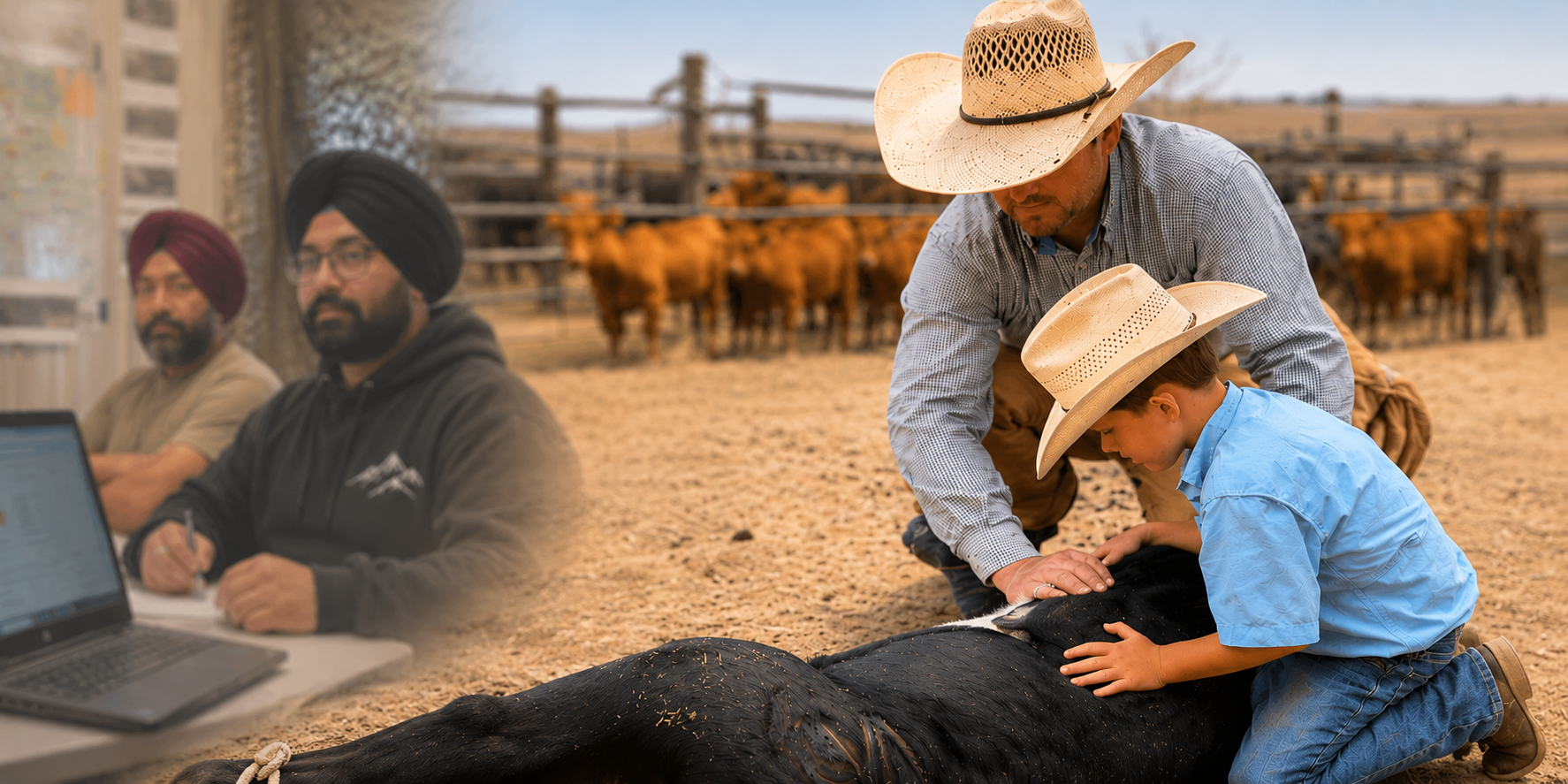
There’s something reassuring about belonging to a profession where a good horse, a sharp pocketknife, and a little common sense can still get you through most of the day.
While much of America has spent the past week discovering just how helpless modern life can become when the computers quit cooperating, cattlemen have been going about their business much as they always have. The cattle still need feeding. The fences still need fixing. And somewhere, a cowboy is still trying to convince a contrary old cow to go through a perfectly good gate.
None of those jobs requires a password.
That’s not to say agriculture hasn’t changed. Far from it. Today’s rancher might check cattle prices on his phone before breakfast, follow a GPS-guided tractor across a field by noon, and purchase replacement bulls online that evening. The same man might spend the next morning horseback, sorting cattle using techniques his grandfather would recognize immediately.
And therein lies something worth celebrating.
A Bad Week for the Digital World
Recent reports of technological disruptions have offered a reminder of just how much modern society depends on systems most of us rarely think about until they stop working.
Microsoft email services, aviation communications, banking networks, and federal agricultural systems have all figured into reports of outages and technical trouble. The incidents have not been established as connected, nor is every outage necessarily the result of a cyberattack.
But the problems at the U.S. Department of Agriculture have been especially relevant to farmers and ranchers.
According to reporting published November 20, USDA experienced a cybersecurity incident that prompted extensive password resets and application restarts. The resulting disruptions affected systems supporting agricultural loans, payments, crop insurance, and Farm Service Agency operations.
Some FSA employees reportedly spent more than a week unable to complete essential work, including enrollments in the Agriculture Risk Coverage and Price Loss Coverage programs.
With the December 11 enrollment deadline approaching, that’s considerably more than an inconvenience.
USDA Undersecretary for Farm Production and Conservation Richard Fordyce said the department’s cybersecurity safeguards worked and that no data was lost. He expected most affected FSA programs to return to operation by Friday evening, with additional work over the weekend if necessary.
That’s welcome news.
Although a farmer trying to finish his paperwork might be forgiven for wondering whether a computer system could be persuaded to protect his information and let him use it.
The incident also illustrates an uncomfortable truth about modern life: we have built extraordinary systems to make ordinary work easier, but when those systems fail, even simple tasks can become remarkably difficult.
Agriculture understands the value of those systems. We also understand the value of knowing what to do when they aren’t available.
Progress Without Forgetting
Spend a little time around a modern cattle operation and you’ll find technology everywhere.
Electronic identification helps producers maintain records. GPS guidance has transformed fieldwork. Weather forecasts, market reports, and commodity prices are available at the touch of a screen. Ranchers can monitor water systems remotely, manage livestock inventories digitally, and reach buyers hundreds of miles away without leaving the kitchen table.
These advances deserve appreciation.
They save time, reduce waste, improve decision-making, and help producers manage operations that would have been difficult to imagine a few generations ago.
But the most remarkable thing about agriculture isn’t how much we’ve changed.
It’s how much we’ve managed to preserve.
A rancher may use satellite imagery to study his pastures, but he still needs to understand the grass growing in them. An electronic tag can identify a cow, but it cannot replace the stockman’s eye that recognizes when she’s about to calve or when something isn’t quite right.
A weather app can tell you a storm is coming. Experience tells you which pasture will provide shelter and whether the cattle ought to be moved before it arrives.
And no matter how sophisticated the equipment becomes, someone still has to know how to use a shovel, stretch a wire, repair a water gap, or get a stubborn calf headed in the right direction.
Technology can make a good cattleman more effective.
It cannot make an inexperienced man a good cattleman simply by putting a screen in his hand.
The Things We Still Teach Our Children
Perhaps the greatest evidence of agriculture’s enduring character can be found at a branding.
Look around the gathering and you’ll see a curious mixture of centuries.
There may be a modern hydraulic chute nearby, pickups equipped with navigation systems parked along the fence, and someone checking a weather forecast on a smartphone.
But down in the dust, much of the work would be familiar to cattlemen from generations past.
A horse turns a calf. A rope comes tight. Someone steps in to help. An older hand offers a correction, and a younger one learns something that cannot be adequately explained in a classroom.
Children watch their fathers, mothers, grandparents, and neighbors. When they’re old enough, they begin helping. At first, the jobs are small. Eventually, they become the people others depend upon.
They learn that livestock must be cared for whether the weather cooperates or not. They learn that a promise to help a neighbor means showing up. They learn that a job worth doing is worth finishing, even when nobody is watching.
And they learn to recognize competence in a way that has very little to do with titles, credentials, or appearances.
The fellow who can calmly sort a difficult bunch of cattle is respected because he knows what he’s doing. The neighbor who shows up with a trailer when someone’s cattle are out doesn’t need an impressive résumé.
His work speaks for itself.
These lessons are not preserved in a computer database. They are preserved in families, communities, and long days spent working alongside people who know their trade.
A child learning to handle a calf today is participating in something that connects him to generations of cattlemen who came before him.
And one day, with a little luck and plenty of patience, he’ll pass that knowledge along to someone else.
A Way of Life That Still Works
There’s a tendency in the modern world to assume that whatever is newest must necessarily be best.
Sometimes that’s true.
Few cattlemen would willingly trade a dependable pickup for a wagon when there’s a long haul ahead. Modern veterinary medicine has saved countless animals. Better equipment has made dangerous jobs safer and exhausting jobs more manageable.
But progress doesn’t require us to discard everything that came before it.
The cattle industry has endured because its people have generally been willing to adopt useful innovations while holding fast to the principles that made their work possible in the first place.
Hard work. Good judgment. Responsibility. Neighborliness. An understanding of animals and the land.
Those qualities don’t become obsolete when someone invents a better machine.
In fact, they become more valuable.
A GPS receiver is a wonderful thing until the signal disappears. A digital recordkeeping system can be indispensable until the power goes out. A remotely controlled water system saves a tremendous amount of driving, but someone still needs to know how to fix the float when it sticks.
There’s comfort in knowing that the technology is there to serve the work, rather than the other way around.
And there’s pride in knowing that if the technology fails, the work doesn’t necessarily have to stop.
That isn’t a rejection of progress.
It’s the independence that comes from understanding your trade.
The Real Wealth of the Cattle Business
Of course, none of this means ranching is easy or that the industry is somehow insulated from the troubles of the modern world.
Cattlemen still depend on banks, markets, transportation networks, federal agencies, and countless other institutions. When those systems fail, producers can suffer real financial consequences.
A rancher may be perfectly capable of gathering his cattle without a computer, but that doesn’t mean he can complete an FSA enrollment when the government’s system is unavailable.
We have every reason to expect the institutions serving agriculture to maintain reliable systems and provide reasonable accommodations when they fail.
Still, the week’s events offer an opportunity to appreciate something that can be easy to overlook amid the daily demands of making a living.
The cattle business has retained a remarkable amount of practical knowledge.
We still know how to read the weather by watching the sky. We still recognize the value of a dependable horse and a well-trained dog. We still gather around branding fires, share meals after a long day’s work, and measure a person’s worth by the way he treats his neighbors and handles his responsibilities.
We still teach our children that the animals come first, that a man’s word ought to mean something, and that there’s satisfaction in doing difficult work well.
These things are not relics.
They are living traditions, practiced every day by people who may never think of themselves as preserving anything particularly important.
They’re simply doing what needs to be done, the way they were taught.
And that’s precisely why those traditions survive.
Some Things Don’t Need a Software Update
There is a certain irony in watching the institutions that promise to make our lives easier grind to a halt when their computers stop working.
Agriculture has not been immune to the technological revolution. Our tractors steer themselves, our cattle markets reach buyers across the country, and our records increasingly live somewhere in a cloud. We have welcomed the tools that make our work more productive, and we would be foolish to pretend they haven’t improved our lives.
But there is a difference between using technology and depending upon it for everything.
A cowboy can still gather cattle without a satellite. A rancher can still recognize a sick calf without an electronic monitor. A horse doesn’t need a software update, and a good stockman doesn’t need an internet connection to know when his cattle need water.
These aren’t quaint remnants of a bygone era. They are practical skills, passed from one generation to the next, that remain as useful today as they were a hundred years ago.
That doesn’t mean agriculture can shrug off the failure of government payment systems, banking networks, or modern communications. Those disruptions have real consequences, and the people responsible for maintaining those systems ought to be held accountable.
But while much of the modern world has traded its old ways for new conveniences, agriculture has largely managed to keep both.
We have incorporated technology without abandoning our traditions. We have learned to work with modern tools without forgetting how to work with our hands.
And perhaps that is one of the greatest strengths of our industry.
When the computers go down, the cattle still need feeding, the fences still need fixing, and the work still needs doing.
Fortunately, we still know how.
Dey Money | Cattle get worked, cowboys get paid.